Welcome, students, to the United States! When you first arrive in the U.S., there’s really no need to rush to figure everything out at once. But there are a few things we recommend starting as early as possible:
- Get SSN / ITIN and other identity-related documents in order;
- Open a suitable U.S. bank account;
- Start building your credit history early;
- Choose a mobile plan that fits your needs;
- Learn how to save money with credit cards, cash back, and various newcomer offers.
These things may seem trivial in the first few months, but later on, when you buy a car, rent an apartment, apply for credit cards, travel, or even take out a loan, their value will gradually become clear.
Contents [Hide]
Reader groups
This article took a long time to put together, pulling together many posts on the blog related to life in the United States, and we hope it can help everyone adapt to life in the U.S. more quickly. We have several U.S. reader groups, and you’re welcome to join. If you run into any problems in the U.S., you can ask questions and exchange ideas in the group. Just add the assistant to be invited into the group.

Identity and documents
In the U.S., it’s important to carry identification documents with you at all times, so it’s best to get the relevant documents as early as possible. Among them, the SSN and driver’s license/State ID are two very important documents.
Social Security Number (SSN)
First, the SSN, short for Social Security Number. If you come to school as a research assistant (RA) or teaching assistant (TA), or are visiting on a J visa, that all counts as having a U.S. job. You need that job and your identity documents to apply for an SSN. You’ll use this number later for taxes, credit card applications, bank accounts, brokerage accounts, and more. You could say it’s the U.S. version of an ID card!

Applying for a U.S. Social Security Number (SSN) usually requires you to visit your local Social Security Administration (SSA) office in person and submit Form SS-5 (Application for a Social Security Card), along with copies of proof of identity, proof of employment (if applicable), and immigration documents (such as I-94, I-20, etc.). The application is free, but after approval it usually takes 2 to 4 weeks for the SSA to mail the Social Security card to the address you provided.
A quick tip: if you are an F1 international student with no job, you can get an SSN by applying for an on-campus job, such as at a dining hall, as a TA, or in the library. The SSN is very important in our personal finances and is a key part of how international students use credit cards to earn points toward flights. After you get your SSN, keep it safe. It’s best not to carry your Social Security card with you, but you should memorize the 9-digit SSN, since it’s needed on many forms.
Real ID/Driver's License/State ID
A driver's license is also very important in the U.S., unless you live in a huge city like New York or Chicago and can rely entirely on public transportation.
ITIN
As mentioned above, the SSN is a very important number for tax filing, credit cards, and bank account applications. If you don’t have a job yet, don’t plan to look for one in the near term, and still want to apply for a U.S. credit card, what should you do? You can apply for an Individual Taxpayer Identification Number (ITIN) instead. See our summary article for the detailed explanation and steps.
- How to apply for a U.S. ITIN [Fully updated for 2025]
- Which U.S. credit cards can you apply for with an ITIN?
Personal finance
A big part of this site is personal finance content. In addition to adjusting to life and studies in the U.S., international students are encouraged to spend some free time learning U.S. personal finance. You can use your own effort to earn free flights and hotel stays, and even make money for living expenses. It’s a great deal.
Credit cards
In the U.S., credit cards not only save you money on everyday spending, they also come with sign-up bonuses of up to $1,000+, letting you enjoy perks like first class, airport lounges, and luxury hotels for free. International students may not earn a lot, but credit card approval requirements are not very high either. By building credit, you can apply for better cards and earn a lot of rewards. We’ve put together beginner articles to help new students build a foundation
- [Beginner guide] How do U.S. credit cards work? Can they save you money—and even make you money?
- 2026 U.S. credit card application roadmap: from your first card to advanced strategies
For new students, it’s best to start by applying for a few no-annual-fee cards. No-annual-fee cards can be kept long term and help build a solid credit foundation.
Of course, if you already have some credit history, you can consider cards with higher sign-up bonuses
- U.S. credit card sign-up bonus rankings (personal cards)
- U.S. business credit card Small Business Card rankings
If you already know the site content, you can also join the more advanced 美卡 101 Knowledge Planet to discuss and exchange ideas
- Read these five questions before joining the 美卡 101 Planet
- Introduction to the benefits of the 美卡 101 Planet
We’ve organized the basic credit card articles, and you can find them in the menu and learn step by step.

Bank accounts
Bank accounts are also very important for personal finance. You need a checking account to receive your salary, accept transfers, pay credit card bills, deposit checks, and more. So we recommend opening one as soon as you arrive in the U.S. However, before you have an SSN, you usually need to open an account at a local bank with your passport, and you may not be eligible for the opening bonus. So it’s best to get your SSN first. In general, we recommend major banks, which offer full services and local branches, making things easier later and helping with credit card applications. Examples include Chase, Bank of America, Citi, and Capital One.
We’ve summarized some good banks, especially those with high opening bonuses, so you can grab the bonus when you open the account
- Bank account opening bonus rankings [2025.9 update: up to $3,000 bonus]
- [Beginner guide] How to get checking and savings account bonuses
Compared with credit cards, bank accounts are simpler and easy to understand. Besides checking accounts, banks also offer savings accounts and certificates of deposit (CDs), which you may also want to learn about
- An introduction to U.S. savings accounts for personal finance
- An introduction to U.S. certificates of deposit (CDs) for personal finance
Brokerage accounts
If you come to the U.S. with some savings or income, you may want to consider investing in U.S. stocks. The U.S. financial markets are well developed and returns can be good. If you research individual stocks, you can buy single stocks; if you don’t have the time or energy, index funds such as QQQ, SPY, and VOO are good choices. Of course, you need to choose the right brokerage platform, balancing high opening bonuses and everyday usability
We’ve organized a menu of U.S. stock articles so you can start with the basics as a beginner.

Tax filing
Taxes are an important part of personal finance in the United States. Whether you have an SSN or ITIN or not, if you have income, you'll have tax issues and need to file a return. Tax software is now well developed, but we still recommend understanding the basic principles of the U.S. tax system. It not only helps with filing, but also guides you in saving on taxes and avoiding unnecessary taxes. Cutting taxable income by 10% is equivalent to increasing income by 10%, which is quite significant.We've compiled some basic ways to save on taxes, which may come in handy once you start working.
- Introduction to U.S. retirement accounts 401(k) and IRA
- For U.S. wage earners, master these four methods and save taxes with retirement accounts!
You can find basic tax-filing content in the menu.

Everyday Life
Mobile Number
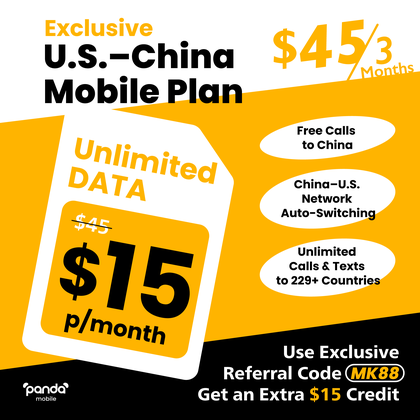
Getting a new phone number when you arrive in the U.S. is a must. The most important thing is choosing the right mobile plan for yourself. There are three common types; choose the one that fits you best.
- Prepaid Plan: for light usage, short-term temporary use, or people who don't want to share a family plan.
- Postpaid Plan: for balanced to heavy usage, with a long-term stable person available to form a family plan. For people who don't want to tinker and don't care about researching ways to save or make money.
- Unlimited number portability: for people interested in researching how to save and make money by porting phone numbers.
See our article
You can also choose the mobile plan we recommend for international students
Saving Money
Saving money is a broad topic, and every store is different; online and offline are different too. Here we'll cover a universal method: use the right credit card for your purchases to get the highest cash back.
In addition to credit cards, online shopping can earn rewards from cash back sites. The process is simple: go to the merchant through the cash back site and the reward is tracked automatically. The following four are useful:
- Rakuten cashback site (formerly Ebates) guide
- TopCashback cashback site guide
- Introduction to the ShopBack cashback site
- TopCashback cashback site guide
There is also a way to save money by buying gift cards; see
The best time to shop is November and December, when merchants offer the biggest discounts. In particular, Black Friday and Christmas each year are when we compile our annual Black Friday deals roundup.
Car-Related
Most people who come to the U.S. will end up buying a new or used car. We've compiled articles about buying and selling cars for reference if needed.
- Super detailed! My experience buying a new car in the U.S. (2020 Corolla LE), bargain OTD $15,800!
- Guide to buying a new car in the U.S. (with personal experience)
- My experience buying a used car on Craigslist in the U.S.
Travel
Once you're in the U.S., you'll always find time to travel during spring break, summer break, or Christmas. If family comes to visit, you can travel together too. Our travel experience focuses on free travel! That's right: from flights to hotels, everything can be free; even business class between China and the U.S., and even Waldorf Astoria. On top of that, credit cards can get you into airport lounges for free, with free food and drinks; rental cars can come with free insurance; rideshares can get free Uber credits; and food delivery can be reimbursed.
Details below.
Flights
Using Google Flights or Priceline to find cheap flights is no longer that exciting. We focus on getting free flights with credit cards. But award tickets have a learning curve, so you'll need to learn how to redeem them.
- [Beginner's Guide] Introduction to airline alliances, miles, and memberships
- Introduction to U.S. airline co-branded credit cards
Learn the basics and look at simple redemptions. Even though cards may be refreshed or changed, the underlying logic stays the same.
- From beginner to pro with credit cards (1) — How to get free flights: sign-up bonuses + award tickets
- From beginner to pro with credit cards (2) — How to get free flights: sign-up bonuses + transfer points + award tickets
If you don't know how to redeem points, you can use our consulting service and achieve business and first-class freedom.
We've organized airline content in the menu for quick lookup. Check out the business-class and first-class reviews below.

Hotels
Hotels are similar. Many credit cards give you a free night certificate every year just for holding the card. Hotel points bonuses are generous, and some cards even offer hotel credits. So hotels can be almost free! Stay at upscale hotels and get free breakfast, room upgrades, and more.
- [Beginner's Guide] One article to help you understand hotel programs and points
- Comparison of U.S. hotel co-branded credit cards [Fully updated 2025.9]
Hotels are simpler than airlines: once you have the points and free-night certificates, you can redeem them directly. If you don't have elite status yet and want free breakfast or upgrades, you can use our channel for a free upgrade! Just book through it.
The site organizes hotel basics and real stay reviews; you can find them in the menu.

Rental Cars
Road trips are common in the U.S. When going to remote attractions or cities with weak public transportation, renting a car is unavoidable. Rental cars are flexible, and splitting the cost among several people makes sense. We've compiled some rental car articles.
In addition to the car rental fee, insurance can be a significant cost, but credit cards can provide free rental car insurance!
- Complete guide to credit card rental car insurance
- Credit card rental car insurance reimbursement experience (Chase Sapphire Preferred)
Family Visiting the U.S.
If you've been in the U.S. for a while, inviting family to visit is common. We've compiled visa and entry articles.
- Latest U.S. B1/B2 travel and family-visit visa application guide
- U.S. visa EVUS registration and form-filling guide
- Guide to transiting to and entering the U.S.
Conclusion
This article took a long time to put together, gathering many U.S.-life articles from the blog. We hope it helps everyone adapt to life in the U.S. more quickly. Our reader group includes many longtime friends who have lived and studied in the U.S. for years, and they help answer questions when they have time. New friends who need it are welcome to join (if the QR code no longer works, please contact the WeChat assistant at uscards101 and note "new student group")